Authors: Carla Sa-Couto, Ingrid Bispo and Abel Nicolau, FMUP
Date: 20.01.2026
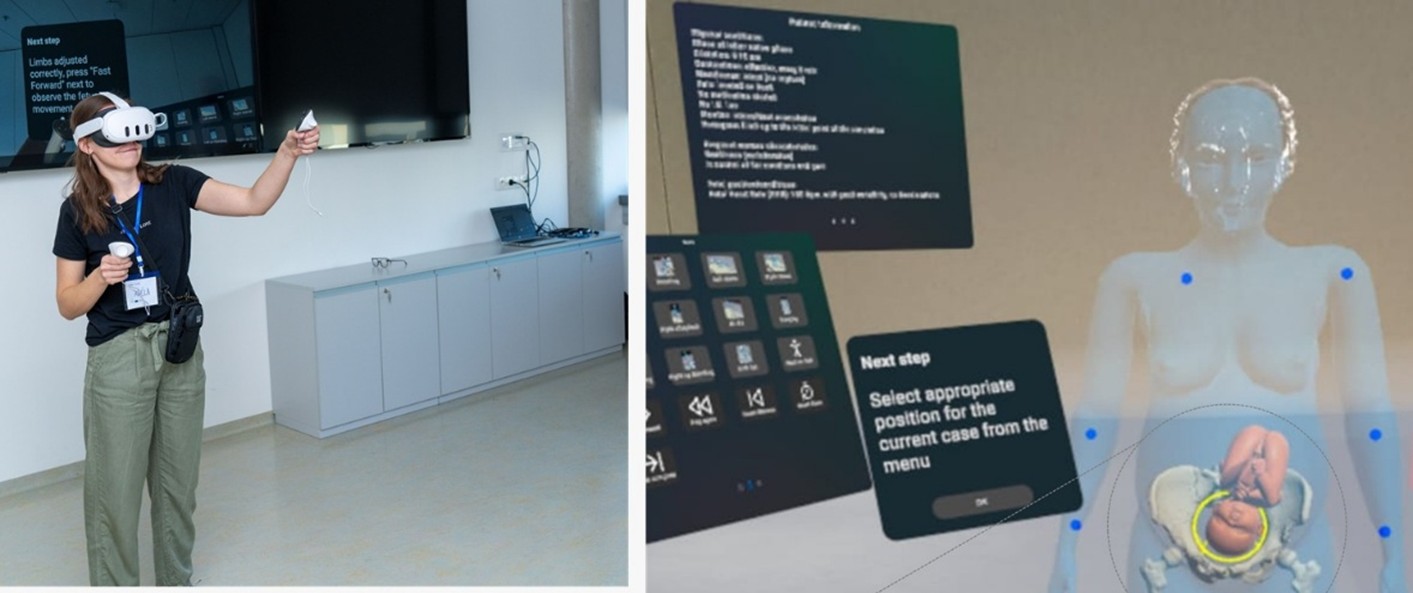
A core component of the PROGRESSION project is the systematic evaluation of both learning outcomes and user experience within immersive educational environments.
To ensure a robust and comparable assessment, standardized evaluation instruments were applied following each Virtual Reality (VR) and Augmented Reality (AR) learning session. These included the System Usability Scale (SUS) and the Virtual Reality System Usability Questionnaire (VRSUQ), complemented by expert-developed questionnaires specifically tailored to the midwifery learning context.
To measure educational impact, knowledge tests were administered before the start of the course and immediately after each immersive session. This approach allowed us to assess short-term learning gains as well as cumulative knowledge development across the full learning experience.
The evaluation results demonstrate a positive cumulative learning effect associated with the PROGRESSION training concept. While the difference between the Pre-Test and Post-Test 1 (following the VR intervention) did not reach statistical significance, a statistically significant improvement was observed between the Pre-Test and Post-Test 2, administered after completion of the full VR–AR learning sequence. Knowledge scores increased from 69 ± 12 to 75 ± 11 points, suggesting that the staged integration of VR and AR supports the reinforcement and consolidation of complex physiological concepts.
In terms of usability, the VR component achieved a mean SUS score of 68, meeting the lower threshold for average usability, alongside a moderate VRSUQ score of 56. In contrast, the AR component received lower usability ratings, with SUS and VRSUQ scores of 55 and 54, respectively. These findings highlight the need for continued technological refinement—particularly in AR interface design—to further enhance user experience and optimize educational effectiveness.