Implementation


Success stories about the PROGRESSION application

As the PROGRESSION project developed and the application evolved more and more, our midwifery institutions were able to test it live and with students who will are inteded to profit from the application in the future and thus better understand learned content and with this positional manoeuvres. We would like to give you as short insight into the testing process its by statement from students about their experiences as well as opinions about the PROGRESSION application.
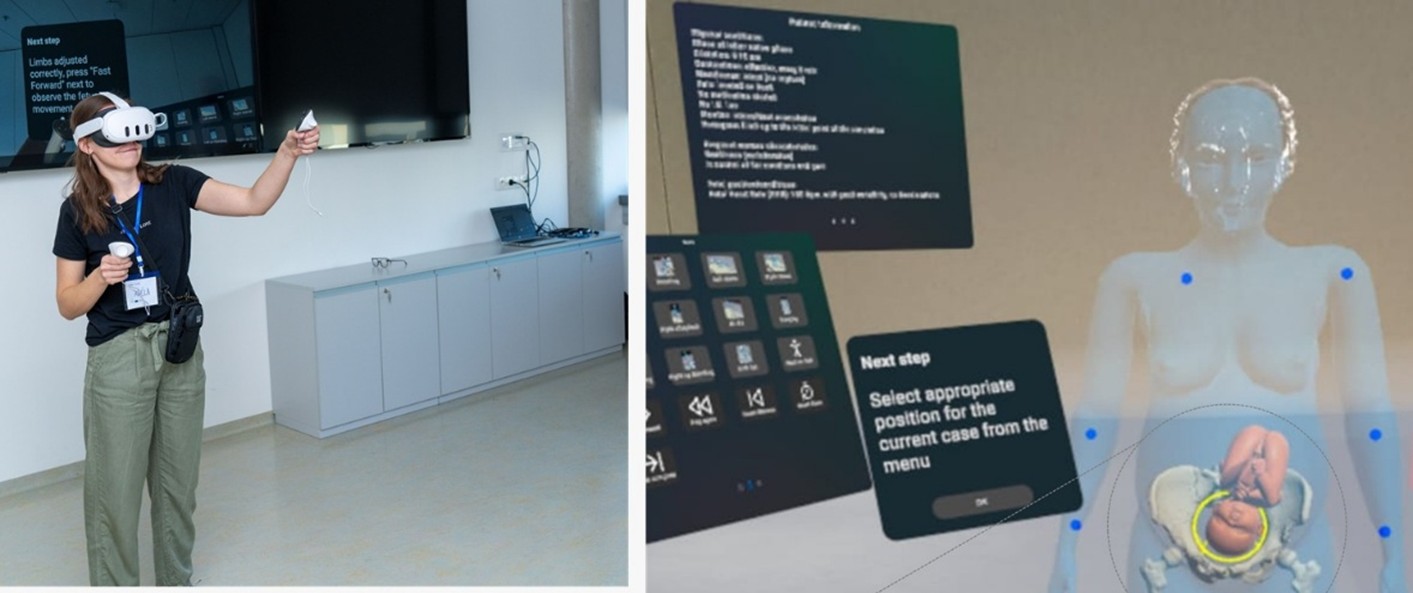

Bild1 


Story 1 - Master’s Student in Midwifery and Maternal Health; ESEP, Portugal

Overall, the VR/AR experience was very positive and engaging, clearly contributing to an understanding of the relationship between the mother's position, the pelvis and the foetus.
The three-dimensional and dynamic visualisation allowed for a better understanding of the mechanisms of labour and the influence of different positions, something that would be more difficult to consolidate with theoretical or two-dimensional resources alone.
The ability to observe changes in real time helped to integrate anatomical and clinical concepts more intuitively. Throughout the evolution of the scenario, I felt that the decision-making process became progressively more structured, as the simulated environment required continuous attention, analysis of the situation, and choice of appropriate interventions.
Solving the clinical case in a virtual context increased the sense of realism and responsibility, which had a positive impact on my self-confidence, especially by allowing me to make mistakes and learn in a safe environment.
The virtual environment facilitated clinical reasoning and promoted a high level of engagement, although, in some initial moments, adapting to the equipment required some additional concentration. However, interaction with the equipment was, in general, intuitive and functional, so I consider it an asset in the learning process.


Story 2 - Master’s Student in Midwifery and Maternal Health;ESEP, Portugal

My opinion regarding my experience with AR/VR, which I strongly believe to be an inspiring and effective strategy in the training of future midwives.
The simulation of clinical cases through virtual/augmented reality allowed for a better understanding of the relationship between the maternal position, the pelvis and the foetus, especially through the three-dimensional and dynamic visualisation of foetal movements and changes in pelvic diameters. This visual experience facilitated the integration of theoretical knowledge into practice, making the relevance of the woman's changing positions during the progression of labour more evident.
Since we were able to use this tool more than once, the decision-making process was perceived in a more conscious and structured way. I highlight the possibility of observing the results of our interventions in real time, which contributed to the basis of clinical reasoning, promoting group reflection.
The resolution of clinical cases through AR/VR was a positive experience, and I strongly believe that it could be an inspiring and effective strategy for future midwives. It contributed to increased self-confidence, allowing for the application of knowledge and its recognition and integration in a safe environment, reinforcing the perception of the ability to deal with similar clinical situations in midwifery practice.
I hope that my sharing will be relevant to the development of this strategy in the future.


Story 3 - Master’s Student in Midwifery and Maternal Health; ESEP, Portugal

The aspects of the simulation that contributed most to understanding the relationship between the maternal position, the pelvis and the foetus were the dynamic visualisation of the anatomical structures and the possibility of modifying the maternal position in real time, according to the clinical case. Direct observation of the impact of these changes on pelvic diameters and foetal orientation and progression allowed for a consolidation of understanding of the interdependence between these three elements. This practical approach facilitated the integration of theoretical knowledge, making the influence of maternal posture and position changes on the effectiveness of labour more evident.
During the evolution of the scenario, the decision-making process was initially more cautious and conditioned by adaptation to the simulated environment. As the simulation progressed, there was greater fluidity in clinical reasoning, supported by continuous analysis of the information available and anticipation of the responses of the maternal-foetal system. This process demonstrated a progressive development in the ability to prioritise interventions and base decisions on clinical and scientific criteria.
Resolving the clinical case was experienced as a demanding challenge, which mobilised technical and cognitive skills. Despite some initial anxiety, the experience had a positive impact on self-confidence, as it allowed knowledge to be applied in a safe and controlled environment, enabling the impact of positions on the maternal pelvis to be verified. The perception of effectiveness in managing the case contributed to reinforcing personal confidence in the ability to act in real clinical contexts.
The virtual environment facilitated clinical reasoning by providing an immersive context that stimulated critical analysis and real-time decision-making. The level of realism of the scenario encouraged active involvement, allowing for significant immersion in the clinical situation presented. This involvement contributed to greater concentration and the effective mobilisation of the knowledge acquired.
Interaction with the equipment and the virtual environment was generally positive. The interface proved to be intuitive and functional, allowing the proposed interventions to be carried out smoothly. Despite some occasional technical constraints, these did not significantly compromise the development of clinical reasoning or the overall learning experience.
It is considered that the experience could be enriched by a greater diversity of clinical scenarios, as well as by the availability of new cases, which would allow for the repetition of practice and the application of knowledge to different clinical situations. The existence of cases with progressive levels of complexity would facilitate the consolidation of clinical reasoning and adaptation to varied contexts. In addition, increasing the sensory realism of the virtual environment would be a significant improvement to further enhance engagement and learning.


Story 4 - Master’s Student in Midwifery and Maternal Health; ESEP, Portugal

My experience with AR/VR simulation was, overall, very positive. I found it very helpful in better understanding the relationship between the position of the foetus and the mother's pelvis because it allows you to see everything more clearly and transparently. The three-dimensional visualisation also allowed me to make decisions more easily and consciously.
During the scenario, I felt confident because I was able to practise in a safe environment without fear of making mistakes.
Interacting with the equipment was easy. I consider it to have been a very useful learning experience.